I want to talk to you about everything that hums beneath the skin of the day — about the way morning light spills like melted gold across unmade beds, about the silence before a storm and how it feels like a held breath between two almost-lovers. I want to talk about old highways and forgotten towns, about the ghosts in roadside motels and the poetry scrawled in bathroom stalls, about politics and power and the quiet corruption that smiles under fluorescent lights. I want to talk about God and doubt in the same sentence, about death as a doorway and memory as a room we keep returning to barefoot.
I want to talk about art — the kind that bruises — about ink-stained fingers and guitars crying in half-empty taverns, about books that smell like dust and rebellion. I want to talk about your childhood, your scars, your favorite songs, the taste of your name when it rests on my tongue like summer rain. I want to talk about space — black holes and constellations — and whether loneliness is just gravity pulling us toward each other.
I want to talk about humor as armor, about the masks we polish, about fear, about ambition, about why we ache for meaning in a world that sells distraction. I want to talk about love — not the soft version, but the feral, thunder-lit kind that shakes picture frames off the walls. I want to talk about the future like it’s a map we’re drawing in neon, about the past like it’s a burning letter we refuse to drop.
Mostly, I want to talk about us — how two minds collide like weather systems, how conversation can feel like standing barefoot in a river of electricity — and how, if you let me, I could stay there for hours, naming every color in your sky.
The bar breathes like an old animal—slow, practiced, familiar with survival. Not alive in any holy sense, just functional. Lights dim enough to forgive faces. Music limps between songs. The floor remembers every spill better than the people who caused them. This place doesn’t ask why you came in. It already knows.
Maynard Wells sits three stools from the end. He learned long ago that the end is a confession and the middle is a lie. He chooses the space where no one expects anything from him. His glass is whiskey because whiskey doesn’t pretend to be anything else. He didn’t need it. That never stopped him before.
Mara works the bar like a priest without absolution. She slides napkins under glasses the way you might tuck dirt over a grave—neat, respectful, temporary. She doesn’t ask Maynard how he’s doing. That’s how he knows she sees him clearly.
To his left, a couple dismantles their life in whispers. The dangerous kind—the kind sharpened over weeks. They smile for the room, but their eyes don’t participate. The man worries the rim of his bottle like it might answer back. The woman studies her drink as if it owes her instructions. Maynard doesn’t know their names, but he knows the posture of people realizing love has become labor.
Across the room, laughter blooms too loud and too fast. A cluster of friends leaning into one another, pretending gravity hasn’t started its work yet. One of them—red jacket, restless hands—keeps checking his phone. Waiting. Everyone here is waiting. They just use different excuses.
Loneliness doesn’t announce itself. It sits down beside you like it’s always belonged there. Orders what you’re already drinking. Says nothing. Maynard respects that. Silence, at least, doesn’t argue.
He tells himself he came here to write. That’s the version he prefers. The truth is messier: he came to be seen without being known. There’s a notebook in his jacket, thick with intention, thin with follow-through. It weighs enough to feel like hope without demanding proof. Writers carry notebooks the way some people carry prayers—unspoken, unfinished, still believed in.
The man at the end of the bar breaks open mid-sentence, spilling a story about a job lost or abandoned. The details shift, but the injustice remains solid. He gestures at empty air, arguing with something that left him years ago. No one interrupts. That’s the rule here. You let people speak until they’re done bleeding.
Maynard wonders what would happen if he spoke. If the truth would come out as poetry or complaint. If it would sound brave or just tired. There’s comfort in staying quiet. Quiet doesn’t get corrected.
Memory shows up wearing a familiar face. Orders the drink she used to love just to see if it still hurts. It does. She believed places like this were confessionals. Said you could hear the truth in how people ordered—neat if they were hiding, on the rocks if they were stalling, cheap if they’d already surrendered. She laughed with her whole body. Leaned in when she talked. Made strangers feel chosen. Maynard loved her for that. Hated himself for needing it. They were good until they made a sport out of wounding each other.
A song everyone knows finds its way out of the jukebox. Heads nod. Someone hums. For a brief moment, the room aligns—strangers stitched together by a chorus that once meant something in another life. Bars are good at compressing time. You can be young and old and heartbroken all at once if the music hits right.
Maynard writes: The mask slips here, but no one notices because everyone is busy adjusting their own. He doesn’t fix it. Overwriting feels like fear.
The door opens. Cold air follows a man who looks like he’s already lost something tonight. He orders a double without looking. Scans the room for a reason to stay. Doesn’t find one. Sits anyway.
Hope is quieter than people expect. It doesn’t shine. It doesn’t ask. It sits in the corner pretending it’s fine either way. Hope has learned manners.
The couple beside him stops whispering. The silence is surgical. The woman delivers a sentence she’s been sharpening for weeks. Clean. Accurate. The man nods like gravity has finally won. They don’t touch. That’s how you know something is finished—or close enough to mourn.
Mara wipes the bar, listening without collecting. Maynard wonders how many versions of the same story she’s heard. People explaining their loneliness as if it needs justification. As if it isn’t just another weather pattern.
He drinks. The burn proves he’s still capable of feeling something sharp. The glass leaves a ring on the bar—evidence that will be erased without ceremony. There’s a lesson there. He ignores it.
The red jacket starts talking about meaning. About how everyone is just trying to be less alone. His friends nod like this speech has been rehearsed in a hundred bars. He means it, though. Meaning doesn’t require originality. Just sincerity.
Maynard writes again: Loneliness isn’t the absence of people. It’s the absence of recognition. That one stays.
A siren passes outside, distant but insistent. The world hasn’t stopped just because they needed a pause. Inside, last call looms. The room groans. No one is eager to return to what’s waiting beyond these walls.
The man at the end pays, tips heavy like an apology, and stumbles toward the door. For a moment, Maynard worries about him. Then he remembers: everyone makes it home somehow. Or they don’t. Worry doesn’t change the math.
He thinks about who he’ll be tomorrow. Which stories he’ll tell. Which ones he’ll bury. This night will shrink into something manageable—a glass, a song, a feeling he never quite named. He’ll describe the bar someday and leave out the important parts because they’re too quiet to explain.
Maynard closes the notebook. Some moments don’t want to be captured. They want to be endured. He pays, thanks Mara, means it. She nods, already turning toward the next confession.
When he stands, the room tilts—not from the drink, but from the weight of everything unsaid. Outside, the street is colder and more honest. Neon buzzes behind him like a dare. He pulls his jacket tight, the notebook warm against his chest, and walks on.
This kind of night doesn’t stay behind when you leave.
The poet never planned on becoming a collector of incidents. He thought poetry would be a clean profession, like arranging stones in a river until they spelled a feeling, or holding a mirror up to the moon and asking it politely to explain itself. He did not know, at first, that poems arrive the way bruises do—unannounced, blooming overnight, tender when touched, impossible to trace back to one clean moment. The poet learned this slowly, through accidents: spilled drinks, missed exits, wrong names spoken at the wrong time, the peculiar violence of memory arriving exactly when it is least invited.
His earliest incident was language itself. Words fell on him like weather, unpredictable and invasive. Some days they were gentle rain, others hail. He remembers the first sentence that ever wounded him: a teacher saying, You have potential, the way someone says this glass might shatter. From then on, he listened carefully to tone, to the way vowels could smile while consonants sharpened their teeth. He understood that words were never neutral. They were always leaning toward consequence.
The poet grew up in rooms full of noise—televisions arguing with each other, adults rehearsing disappointments, clocks that sounded like insects trapped in boxes. Silence was rare, so he learned to carve it. He would slip away to stairwells, to backyards at dusk, to the hollow between his ribs where nobody else could fit. There, incidents gathered quietly: the smell of cut grass mixing with gasoline, the hum of streetlights warming up, the way loneliness could feel almost holy if you stayed still long enough.
Accidents followed him like stray dogs. He tripped over them. He fed them without meaning to. Once, he fell in love by mistake—thought it was admiration, or curiosity, or the simple gravity between two bodies sharing a bus stop. That accident left a scar shaped like a question mark. Another time, he stayed too long in a job that bored him, mistaking endurance for virtue. That accident left him with a vocabulary of fluorescent lights, break-room coffee, and the particular despair of watching minutes behave like hours.
The poet noticed that incidents were loud when they happened but quiet afterward, while accidents were silent at first and then grew mouths. An incident might be a door slammed, a phone call received at midnight, a sudden laughter that felt inappropriate and therefore necessary. An accident might be the way he started flinching at compliments, or how Sundays began to feel heavier than Mondays. Poetry, he realized, was not about choosing one over the other. It was about admitting both had happened to him.
He wrote wherever the accidents caught him. On receipts, on napkins, on the backs of envelopes addressed to people he no longer spoke to. Ink bled through paper like truth through denial. Sometimes his handwriting shook, not from fear, but from recognition. The body knows when it is being honest, and it rarely cooperates. He learned to forgive himself for messiness. Clean lines, he discovered, often lied.
Color came to him late. For a long time, the poet believed the world was mostly gray, with occasional bursts of red reserved for emergencies. Then one afternoon, while waiting at a crosswalk, he noticed how yellow could feel aggressive, how blue could feel apologetic, how green could ache with patience. From that day on, color became a language he trusted more than grammar. He wrote about bruised purples, jealous oranges, the exhausted beige of office walls, the obscene pink of sunsets that seemed to mock human suffering by being beautiful anyway.
Some incidents were inherited. He carried other people’s accidents in his pockets without knowing it: a grandfather’s silence, a mother’s worry folded into neat squares, a father’s temper that arrived like weather fronts. These were not his faults, but they were his materials. The poet understood that blood is a kind of ink, and family stories stain whatever page they touch. He did not try to wash them out. He wrote around them, through them, sometimes directly into them, letting the page absorb what it could.
Love, when it arrived again, did so clumsily. It knocked over lamps. It misunderstood metaphors. It wanted certainty in a house built of drafts. The poet tried to explain himself, but explanation is a poor substitute for presence. This love became both incident and accident: the meeting intentional, the aftermath chaotic. There were mornings filled with light and coffee and shared silence, and nights where words collapsed under the weight of what they were asked to carry. When it ended, it did not explode. It evaporated, leaving behind a residue the poet kept mistaking for hope.
He wrote that too. He wrote about the way endings rarely announce themselves, how they prefer to slip out the back door while you’re still setting the table. He wrote about the sound of a phone that doesn’t ring, the particular cruelty of “take care,” the way memory edits people into kinder versions of themselves. These poems were quieter, but they lasted longer. They sat in the reader like a held breath.
The poet’s body became another archive of accidents. Knees that predicted rain. A shoulder that remembered a fall from years ago. A heart that skipped not from romance but from anxiety. Doctors offered names. He preferred metaphors. It wasn’t denial; it was translation. Saying my chest is a crowded room felt more accurate than saying stress. Saying my bones are tired of holding me up felt truer than saying fatigue. Poetry did not cure him, but it made him legible to himself.
There were incidents of joy, too, though he trusted them less. A song played at exactly the right moment. A stranger’s kindness delivered without ceremony. A line he wrote that surprised him by being good. These moments felt like gifts left on his doorstep by someone who refused to sign their name. He accepted them cautiously, knowing how quickly joy can turn into expectation, and expectation into resentment. Still, he wrote them down, because gratitude deserves a record.
The poet argued often with purpose. People asked him what his work was for, as if poems were tools meant to tighten bolts or fix leaks. He tried to answer politely. Sometimes he said poems were for survival. Sometimes he said they were for beauty. Sometimes he said they were accidents themselves—collisions between experience and language that left debris worth examining. Most of the time, he smiled and changed the subject. Purpose, he learned, is another word that carries a lot of hidden pressure.
Time behaved strangely around him. Years sped up, days stalled, moments stretched thin as plastic wrap. Incidents aged poorly or beautifully depending on how often he revisited them. Accidents matured like wine or soured like milk left out too long. Memory was not a reliable narrator, but it was persistent. The poet stopped trying to correct it. Instead, he let it speak, knowing that even lies reveal something about desire.
There were periods of silence when he wrote nothing. These were not failures, though they felt like it. They were accidents of depletion. The well does not always refill on schedule. During those times, he lived more. He watched people. He listened. He made mistakes without documenting them. He let incidents pass unharvested. When language returned, it did so ravenous, hungry for everything he had refused to name.
He noticed, eventually, that readers recognized themselves in his accidents more than his incidents. Anyone can relate to a car crash, a breakup, a shouted argument. Fewer people admit to the slow erosion, the unnamed habits, the subtle compromises that shape a life. When someone told him a poem felt too real, he understood it as a compliment and a warning. He had touched something tender. He had described an accident people prefer to call fate.
The poet aged into himself. The urgency softened but did not disappear. He became less interested in being impressive and more interested in being precise. Big words gave way to exact ones. He learned that honesty is not loud. It hums. It vibrates. It waits. Color remained, but it deepened—less neon, more dusk. His poems began to feel like rooms rather than performances, places where a reader could sit without being asked to clap.
In the end—though there is no true end—the poet accepted that his life would never organize itself neatly. Incidents would continue to interrupt. Accidents would keep revealing themselves years after the fact. Poetry would remain an imperfect map of a shifting terrain. This did not depress him. It relieved him. Perfection, he realized, leaves no room for witnesses.
So he kept writing. Not to prevent accidents, not to glorify incidents, but to mark where he had been. Each poem became a small flag planted in the chaos, saying: I was here. This happened. This almost happened. This happened differently than I remember, but I remember it anyway. Color spilled. Language bled. Meaning flickered and held.
And somewhere between the stumble and the stride, between what broke and what survived, the poet found a strange, durable grace—not in control, not in certainty, but in the ongoing willingness to pay attention.
I want to die on my birthday, not because I hate living, but because I am tired of the arithmetic of it, the way years stack like unpaid bills, the way candles turn into tiny interrogations asking what I did with the light. On that day the calendar claps, people text confetti, and I feel like a guest of honor at my own inquest, smiling while the room waits for a speech I never practiced. Birthdays pretend to be doors; mostly they are mirrors, and I am sick of learning my face by surprise.
I want to die on my birthday the way a song wants to end on its own chord, not dragged into an encore by polite applause. I imagine the cake sweating sugar, the knife clean and ceremonial, the wishes folding themselves into paper boats that refuse to float. I imagine the room forgiving me for leaving early, the clock loosening its grip, the candles admitting they were tired too. This is not a plan, it is a metaphor I keep touching like a bruise to see if it still hurts.
Every year arrives with a receipt. It itemizes mistakes, discounts the miracles, charges interest on love. I have learned how to carry gifts with one arm and grief with the other, how to say thank you while inventorying exits. The party hats fit like borrowed confidence. Laughter behaves, obedient as a trained animal. Inside me, something feral circles the truth, asking whether survival is a habit or a choice.
If I could choose the ending, I would choose a quiet that knows my name. I would choose to lay down the weight of being seen, the exhausting labor of translation between who I am and who I perform. I would choose to stop proving endurance is a virtue. The body keeps score, they say; mine keeps ledgers, tallies nights slept in pieces, mornings stitched together with coffee and resolve.
Still, birthdays are stubborn. They keep showing up with balloons like minor gods, insisting on witness. Friends insist too, their hands warm, their eyes unsolved. Love is an interruption I never schedule but always answer. It knocks with groceries and bad jokes and the audacity to believe tomorrow is not a trap. Sometimes I let it in. Sometimes it stays.
So if I say I want to die on my birthday, hear the grammar beneath it. I want an ending that listens. I want the counting to stop hurting. I want to blow out the candles and not be afraid of the dark that follows. I want to live long enough to learn another language for staying, one where the date on the cake is not a verdict but a comma, and the sentence keeps breathing. Maybe the wish is simpler: to be held without a stopwatch, to be celebrated without being measured, to be allowed a softness that does not require proof. Maybe the wish is to keep arriving, quietly, without fireworks, learning how to stand in the year like weather, changing, survivable. If there is a gift, let it be this: another breath that does not owe anyone an explanation, wrapped, opened, kept.
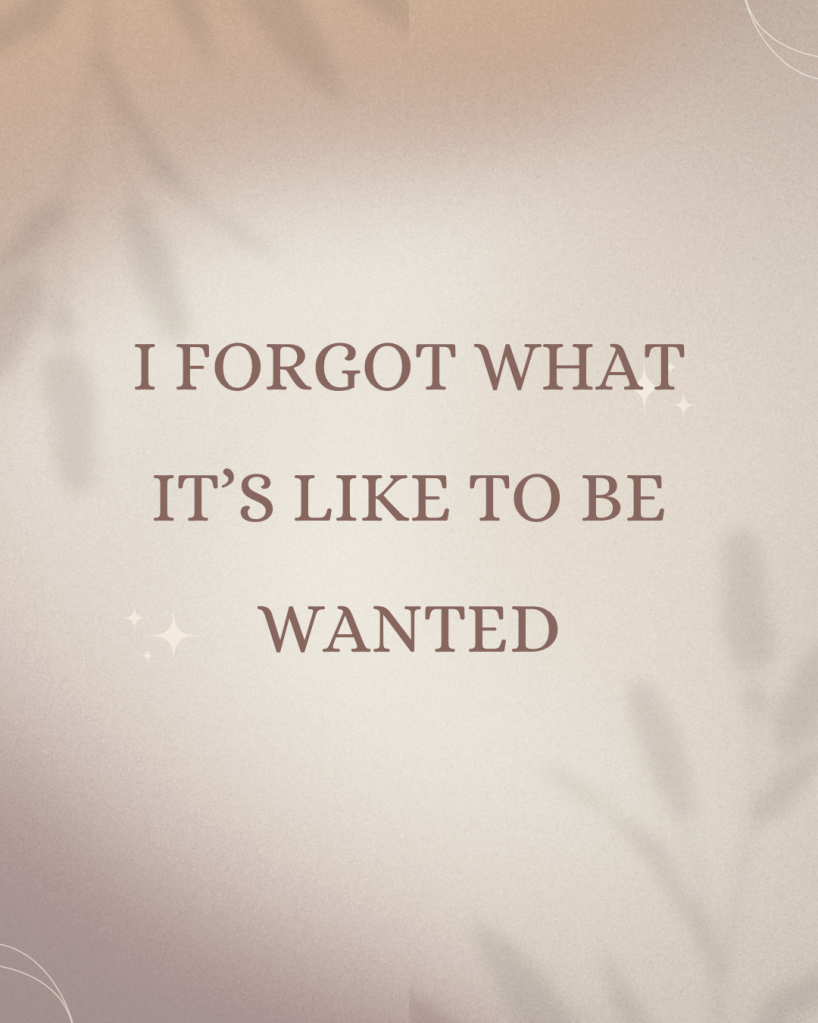
I forgot what it’s like to be wanted, and I don’t mean needed in the utilitarian sense, like a spare key or a reliable paycheck, but wanted in the way thunderstorms want open fields and mouths want names whispered into them. There was a time when desire arrived without asking for permission, when it leaned into me with its elbows on the table and said, you, as if no other option had ever existed. Back then, I didn’t have to audition for attention; it found me mid-sentence, mid-thought, mid-flaw, and decided to stay. Now everything is scheduled, measured, softened. Affection comes with disclaimers. Attraction clears its throat before speaking. People circle each other like polite planets, careful not to disrupt the furniture. I have become very good at being agreeable, very good at being digestible, very good at being the kind of person you admire quietly and forget loudly. I fold myself neatly into conversations, make room, ask questions, laugh on cue. I am impressive in a way that doesn’t interrupt anyone’s life. I am safe. I am considerate. I am never the thing that ruins sleep. Wanting used to be loud with me. It used to spill drinks and forget plans and text twice in a row without apology. It used to look at me like a problem it was excited to solve. Somewhere along the way, I became a suggestion instead of a craving. A “maybe” instead of a pull. I watch desire now the way you watch weather through a window—aware it exists, unsure how it feels on skin. Sometimes it almost remembers me: a glance that lingers too long, a hand that hesitates before pulling away, a joke that lands closer than expected. But it always corrects itself. Responsibility clears its throat. Long-term thinking wins. I forgot what it’s like to be wanted without a risk assessment, without a pros-and-cons list, without the need to explain myself in advance. I tell myself I am whole, and I believe it, mostly. I am not broken. I am just untouched in the places that used to feel electric. Still, there are nights when I miss being the hunger, when I miss being chosen with urgency, when I miss someone looking at me like restraint is a temporary inconvenience. I forgot what it’s like to be wanted, but I remember what it’s like to ache, and that feels like proof. Wanting is still alive in me, pacing, impatient, waiting for someone brave or foolish enough to knock without manners and mean it.
Once upon a scattered verse, I woke inside a sentence that refused to end. Ink dripped from the ceiling like old rain, letters crawling the walls, whispering my name as if they knew me better than the world ever had. The room was built of margins, left and right pressing inward, and every breath tasted like dusted books that had not been opened since their spines learned how to crack. I could not tell if I was young there, or old, or neither at all. Time doesn’t matter when no one is watching. I carried a pen like a dull blade, hoping if I pressed hard enough it might finally cut through silence. Outside the window, the moon hung crooked, a pale editor with nothing to say, and the stars looked like misplaced punctuation in a sentence no one bothered to finish.
I wrote because the quiet was too loud. I wrote because the walls leaned closer every time I tried to speak. I wrote about rivers swallowing names, about lovers who forgot the sound of their own laughter, about graves filled with unread prayers. I wrote until my fingers bruised purple, until the paper drank me dry, until my heart learned the steady rhythm of erasure. But no one came. There was no knock, no breath beneath the door. The world moved on with cleaner hands, scrolling past my life like an advertisement they could not skip fast enough. My words lay stacked in neat little coffins, titles etched like headstones, waiting for eyes that never arrived to pronounce them alive.
I imagined readers the way children imagine ghosts, half-hoping, half-afraid, convinced they were near. I pictured someone under a dim lamp at midnight, finding themselves inside my metaphors, feeling less alone because I had bled honestly. But imagination is a cruel lullaby. It tucks you in and leaves the window open for despair to climb inside. The nightmare deepened. Libraries turned their backs on me. Bookstores locked their doors with polished smiles. Even the wind refused to carry my lines, dropping them in gutters where rain smudged meaning into gray apology. I watched my poems age without witnesses, their voices cracking like neglected instruments left to rot in quiet rooms.
There is a special kind of decay reserved for unseen art. It does not scream; it wilts. It curls inward, questioning its own worth, asking if beauty exists at all without a gaze to confirm it. I felt that rot settle inside my chest, a slow mold growing over hope, soft and persistent, impossible to scrape away. I tried to write lighter things—sunrise, redemption, hands finding hands—but the words knew better than I did. They sagged, heavy with the truth that joy still wants to be witnessed. Even happiness grows lonely in a vacuum. Even miracles want applause, or at least a quiet nod from someone who understands.
So I returned to the dark. I described nights that chew on your spine, mirrors that refuse to reflect anything kind, dreams that end right before salvation. I became fluent in grief, conversational in despair, because sorrow, at least, kept me company. It sat beside me like a loyal stray, sharing its bones, never asking me to stop. I wrote my name again and again, afraid it would disappear if I didn’t. I tucked it between metaphors, hid it under enjambment, hoping someday someone would find it like a pressed flower in an old book and wonder who I had been. Legacy is a fragile thing when no one is listening.
The nightmare showed me the future. My notebooks boxed and labeled miscellaneous. My hard drive failing without ceremony. My words dissolving into obsolete formats. There was no obituary for the poems, no footnote acknowledging their effort. Just silence, vast and unmarked, stretching farther than language could reach. I screamed, but it came out as sentence. I begged, but it shaped itself into paragraph. Everything I felt turned into something beautiful, and that was the cruelest part of all. Beauty with no witness is still beauty, but it hurts like loving someone who will never learn your name.
At the center of the nightmare, I met myself as a child, holding a notebook too big for his hands. He looked up at me and asked if anyone heard us. I searched for an answer strong enough to survive the question and found none. So I lied. I told him yes, someday, because hope, even when false, is gentler than the truth. When I woke, the room was the same. Morning did not change anything. The world still spun without my voice, and my poems still waited, patient as graves. But I sat up anyway. I picked up the pen. Not because someone was watching, but because stopping would mean the nightmare had won.
I write for the unseen. For the maybe. For the never. For the chance that one day a stranger will stumble into my darkness and recognize it as their own. Until then, I haunt the page, a ghost made of ink and persistence, dreaming of eyes, dreaming of touch, dreaming—still—of being read.
Once upon a midnight fear, you will not see the echoes of my tears, because they learned to walk softly, barefoot through the house of my chest, passing clocks that cough and calendars that bruise. This is how the story begins: the way sleep explains itself to the sea, with a hush mistaken for mercy. There was a town once, built entirely of punctuation, comma streets and ellipsis alleys, where laughter leaned like tired lampposts and rumors kept bees. I lived there briefly, renting a window, watching the moon practice apologies in the tin mirrors of rooftops. Satire was the local weather, a persistent drizzle that made even statues blink and reconsider themselves.
One evening the ground cleared its throat. Dogs began writing letters to the dark. Teacups clinked like nervous teeth. The earth—an old poet with arthritis—shifted a word and cracked the sentence. We called it an earthquake, because we are afraid of naming confessions honestly. I was carrying a pocket of stars then, contraband hope wrapped in a receipt, when the tremor bowed politely, like a waiter, and asked my name. I gave it a nickname instead, because truth grows shy in public, and the nickname tasted of copper and rain.
Stories fell from shelves, their spines sighing as they hit the floor. A map unlearned its borders. My shadow slipped on a metaphor and laughed, which felt briefly illegal. In the dust I found a childhood still warm, still breathing, counting marbles like prayers. Satirical saints wagged their halos and said this was character development, selling postcards of ruin with inspirational fonts, while a sparrow stitched the air, threading silence through rubble until the silence held.
I followed a crack in the street the way one follows a river that already knows your future. It led to a theater with no roof, where clouds rehearsed tragedies and understudies called thunder. The stage manager was a patient ant keeping notes with crumbs. There, a woman named Gravity sang lullabies in a minor key, braiding ankles to floors and memories to doors. She sang of falling as pilgrimage, of bruises as stamps in a passport, and I stamped willingly. Dreams queued politely nearby, holding numbers, waiting to explain themselves. One wore my father’s coat and smelled of winter and oranges, and told me to forgive the ground for wanting to move on.
The quake softened, a loosening hand. Buildings exhaled. A piano found its missing leg and forgave the floor. We swept metaphors into piles labeled Later, Maybe, Never, and pretended this was normal. At dawn the sky brought coffee; steam rose like a forgiven rumor. I wrote apologies to the cracks and they wrote back, unsigned, saying they only wanted to be heard. I pressed my ear to the street and listened to the earth practice empathy.
I left town with a suitcase of aftershocks, each one a small bell. On the road, satire waved from ditches holding signs that promised detours to meaning. I laughed, then slowed, then listened. Time limped afterward, hands bandaged with patience, agreeing to walk slower for the wounded. Neighbors traded sugar for stories and salt for names we forgot to say. Mirrors learned manners, tilting their faces to flatter survival. A philosopher in the square juggled apples and dropped questions on purpose, saying certainty bruises easily and doubt is a feather mattress. Children chalked hopscotch across fault lines, jumping from Before to After, their laughter forming a bridge no engineer approved.
Bread rose despite instructions. Yeast preached resurrection to ovens. We ate metaphors warm, buttered with relief, crumbs mapping constellations on our shirts. Someone toasted absence and clinked a glass, and the glass forgave gravity again. I mailed a letter to the future without an address, only a mood. The stamp was a leaf. The postmark read, Whenever you’re ready. The future replied with a dream wrapped in newspaper, smelling of ink, the headline screaming that I survived myself.
Night rehearsed gently then, a lullaby with commas for stars. The moon stopped apologizing and listened. I slept with my shoes by the bed, in case the earth asked me to dance. Now the town is quieter. Punctuation has grown gardens. Ellipses bloom like pauses. Cracks are filled with gold because we learned a trick from old bowls: breakage can be an instruction manual. I keep the bells from my suitcase and ring them when words grow stubborn. They remind me that movement is a language, that fear read slowly is only a letter begging for context. So I write softly, and the ground answers softer still, and if the page trembles I breathe ink, count heartbeats, trust margins and footsteps, trusting that even endings are temporary shelters humming quietly while we learn balance beneath forgiving skies.
The poet’s tears do not rush. They gather slowly, like words circling a thought they are afraid to land on. They rise from the chest, where memory keeps its quiet archives, and they taste of all the moments that were almost spoken but never survived the air. Each tear carries a small history, a sentence unfinished, a love that learned to live in silence.
When they fall, they are not asking for mercy. They are translating feeling into something the body can release. Salt becomes language. The face becomes a page. The tear traces a line the poet could not yet write, slipping past grammar, past reason, past pride. It is a confession without audience, a prayer whispered to no one in particular.
Some tears are born from wonder—how beauty persists even after being wounded, how light still finds broken places and calls them holy. Others come heavy with grief, thick with nights that stretched too long and mornings that arrived empty-handed. These tears do not shout; they endure. They know the shape of loss and the patience of waiting.
The poet wipes their face and pretends the moment has passed, but it never does. The tears dry and move inward, settling between metaphors, breathing beneath the pauses, softening the sharp edges of truth. They become the weight behind every line, the ache that makes language honest.
For the poet’s tears are not an ending. They are the origin. They are the quiet proof that something mattered enough to break open, that the heart dared to feel deeply in a world that teaches restraint. And long after the eyes are dry, the tears remain—alive in the prose, asking the reader to feel them too.
I write poetry the way some people light candles in a dark room—not to banish the darkness, but to learn its shapes, to watch how it bends around the flame and softens its edges. There are things inside me that refuse the straight lines of sentences. They coil and wander like rivers that know where they are going but refuse to hurry. Poetry gives them room to meander, to flood, to leave their mark.
Silence has always spoken to me in color. It arrives as indigo pauses, amber echoes, bruised violets of unsaid things. I feel it humming in my ribs, tapping gently on the chest, asking to be translated. When I write, I am not inventing feeling—I am uncovering it, brushing dust from what was already breathing beneath the surface. Words become a prism, splitting a single ache into a spectrum of meaning, each shade telling its own quiet truth.
I write to bleed without injury, to confess without a courtroom, to lay my heart on the page without asking it to behave. On the page, pain becomes ink instead of weight, beauty becomes honest instead of ornamental. Every line is an act of alchemy—grief turned gold, longing turned light, memory given a second heartbeat. The past loosens its grip when it is named, when it is allowed to sing instead of haunt.
Poetry is the one place I am not asked to explain my depth, to simplify my storms, or to quiet my wonder. It allows me to be both blade and bloom, thunder and prayer. In its margins, I am free to be unfinished, contradictory, human. I can stand barefoot in my own contradictions and call it truth.
I write because time erases so much, and poetry resists erasure. It bottles moments like fireflies, small and glowing, refusing to disappear. It teaches me to listen—to the ache beneath laughter, to the hope hidden in exhaustion, to the sacredness tucked inside ordinary hours. Writing becomes a ritual, a way of kneeling before life as it is, not as I wish it to be.
Greetings taxpayers, screen wanderers, and head nodding citizens, let’s dive into the ramifications of ignoring the siren of western civilization, where the infrastructure has had a crack for generations, the colors of the flag have become evanescent, where celebrities are glorified more than soldiers, where the all mighty dollar has more value than life,
Let me introduce myself, I am the Headstone Prophet, the accountant of distractions and destruction, I don’t see black and white, gender, classes, or status, I see authority and figureheads with meaningless titles serve themselves rather than society, I see inflation and corruption welded together to spark the genocide, I am the soothsayer that is gawking at the cemeteries, counting the caskets, I wear a tattoo on my middle finger that reads “The new world order doesn’t deserve a quarter,”
Behind closed doors, the henchmen are sipping on wealth mumbling “if you aren’t rich, you will become my bitch” and the others are ranting “if you aren’t in the grave, you will be my slave,” the catchphrases are lightning and the thunder to their ears, the powers that be want division among the dwellers, they crave disunity and friction, for every label there is a asterisk and a war,
It’s time to pay close attention to these staggering numbers, human trafficking is up twenty percent, the dishonesty among politicians is up a thousand percent, the media will twist the truth fifty percent, the longer you are glued to a screen the quicker you will forget the american dream, in the end the government cares about you is zero percent,
I am the headstone prophet, I stand before you to be the alarm, I stand here to wake up for those who are asleep, I stand here to deliver the most important message of your life, I stand here to hopefully avoid counting your coffin,
(1st Verse) Once upon a midnight breeze I inhaled mourning and choked on my tragedies and I begin to stare into the raven’s lungs I began to speak with animosity on my tongue and I begin to allow the poison seep in my skin I am the one who carries truth laced in sin
CHORUS: I woke up to the sound of the blackout’s rattle crawling between insomnia and my battles my ears are bleeding from my punctured eardrum crawling between my stolen lies and the bullets of my gun
(2nd Verse) I exhaled bitterness and coughed up illusions and I begin to dance with my spots of my confusion I began to shout with sorrow dripping from my lips and I begin to allow the ignorance give me a lethal kiss I began to shed the light and my heart turned to stone I am the one who walks with fear and brittle bones
CHORUS: I woke up to the sound of the blackout’s rattle crawling between insomnia and my battles my ears are bleeding from my punctured eardrum crawling between my stolen lies and the bullets of my gun
Bridge: Once upon a thousand lies truth disappears as followers wave goodbye The paint on the face begins to dry as everything alive begins to die
CHORUS: I woke up to the sound of the blackout’s rattle crawling between insomnia and my battles my ears are bleeding from my punctured eardrum crawling between my stolen lies and the bullets of my gun
CHORUS: I woke up to the sound of the blackout’s rattle crawling between insomnia and my battles my ears are bleeding from my punctured eardrum crawling between my stolen lies and the bullets of my gun
Don’t pull the trigger, get on your knees Look up to God and believe
Growth is powerful. Often times you can’t see how much you have grown until you look back at who you were or what you have decided to let go. I have been writing for decades and have kept it a secret. Why? The reasons why I write are endless. It’s therapeutic, mentally stimulating, challenging, a place where I can voice my opinions, and today I believe others can find others or themselves in my poetry. It can be a place of self discovery and reflection.
Generally speaking, the perspective of a poet by society is someone who is broken, emotionally sensitive, and their voice is better articulated through words on paper than being spoken. To clarify this, written words are better used to express themselves emotionally. I can relate to this part. I am an emotional person and often times I cry because I have no words at times. Today I write with more of bigger purpose. I want to show the world that you people are not broken, they are just misunderstood. They are not surrounded by the right people.
At the end of my first marriage, I took it upon myself to attend therapy. I knew there were some things about me I needed to fix. I am a work in progress, in fact we all are a work in progress and under construction. Two of the things in my marriage that I needed to work on was speaking up for myself and taking control of certain aspects of my life. I was married to a woman who was overbearing, domineering and controlling. She was also an alcoholic. On my end, I wasn’t mature enough to walk away and sought out attention in the wrong way ways. I hid my writing at this time. Therapy gave me guidance and direction.
One of the things that I learned in therapy is that my growth was limited due to my surroundings. My father is quite judgmental and critical. Once I remarried and moved away, my confidence in myself flourished. I saw that I needed to move away. I will never tell my father that because I know that would hurt his feelings. I appreciate all that he is given me and the love that he knows how to give. He doesn’t just seem to care how to present sensitive topics, and how you present them often times is more important than what you say. As I get older, I’m trying to be aware of how I present subjects as well. There is a time to be straight forward, direct and there is a time to communicate with compassion.
In the end, I have grown to try to see the world and life through others eyes. I am not dead set on being right and if I am wrong, I will own up to it. I write poetry from the clouds with eagle eyes and try to embrace humanity. I see humanity without labels. There is a long list of individuals who want the world to change and I stand in a small line where I want to change the world. Everything is perspective and perspective is everything.
I was born with a second hand smile from the sunset. I walk with a tiny wheel in my pocket that won’t roll and converse with a novocaine tongue. I have a brother that uses me as a punchline in off color jokes and a sister with suspicion waltzing in her eyes. I have a mother who was buried at the Brookside cemetery under a choked up moon. I count my blessings rather than my drops of misery. Every now and then she looks at me says “It’s been a while since I’ve seen your second hand smile.”
I’ve tried to turn off the waterfall and dive into the river of flames. I’ve tired to stare into my silent villains and face my inward wars. I’ve tried to run from the screams but I am still in this seared skin. It feels like I’m never going to win.
I was born with a tattoo of a tear on my left cheek. I fumble through the streets with my blood not moving a centimeter. I have a snapshot of my apprehension and a voice that no know wants to hear. I have a mother that appreciated the words I tucked away from the heartless universe. Every now and then she looks at me says “It’s been a while since I’ve seen your second hand smile.”
I’ve tried to shrug off the heartache and walk away from senseless battles. I’ve tried to keep my swollen chin up and to listen to the fireflies in the pitch black. I can keep running in this burnt skin. It feels like I’m never going to win.
I was born with doubt flickering like a light on the inside. I stumble throughout the darkness gripping on to the glow. I have fluttering secrets and camouflaged my excuses to try to erase away the damage. I have a mother who wore a grin throughout her scowling hours. She defied being defeated nor broken down. Every now and then she looks at me says “It’s been a while since I’ve seen your second hand smile.”
I’ve tried to lose my biographical sighs and replace my intuition with logic. I’ve tried to step into my perspective and turn my head to see another view. But all I can feel is you. I have no where to begin. I’ve learned to accept that I just won’t win.
I threw a boomerang into the laced up moonlight and it didn’t return. I said I love you for the first time and she didn’t say a word. I became astray in my depth perception and lost myself within our connection. I turned my head and tried to forget what I just said. I memorized the look on her face and nothing ever could take its place.
I wrote a letter to forgiveness but it was returned to the sender. I want to erase the pain, draw a blank, throw away the last November. I said I deeply care, I know something special is there, all that was uttered “Life isn’t fair.” My heart wanted to shatter believing nothing else mattered. I could tell it was all a mistake, I could feel the tenderness break, and my hands begin to shake.
I tried to hold her hand, to make her understand, that everything changed. When I tried to move, I could feel all that I would lose and cried staring at the remains. I could feel the wind whip into another direction, leaving behind all the affection. Nothing felt right, I didn’t have the energy to fight and wanted to blame the laced up moonlight. I heard from a friend she passed away from a transparent disease. The sadness from the message left a numbing breeze. Never have I felt so isolated and in a pitch black space . The phrase “Life isn’t fair” left a shadow on my face.
I am the color black wrapped up in a midnight curse torture dripping down my bleached face gripping on to the endangered lies whispers growling in my prejudice ears sorrow was a door to throw away my beliefs clutching on to the skeleton chain tomorrow weeps from my skewed perception, stumbling in the waterfalls, praying to blurry shadows and the sinister moon, I sip on the poison of a poor man’s cup and I hide in the mist to make me blind Lord, save me from the lake of screams
I am the color black severed from the spinning rainbow buzzards flying around my dying tree decaying stains, fumbling in the dark crawling toward the vibrations of the stigma haunted by my twitching nerves anxiety and insecurities boiling on the inside grief jumbled, agony waltzing carrying heartbreak over my shoulders I quietly stare into the atoms of my distress molecules sizzling, bloodstream crying depths of discomfort, circling headaches and I seek grace with a pitchfork and knives Lord, save me from the lake of screams
I am the color black ripped from the sobbing vermillion sky distinctively malevolent, serene and ill tarnished and frozen, inside the frostbite slightly obscene, smothered in vile a predator within, carrying a tarantula grin vertigo parading, obscurity blending corrosion running down my esophagus A diabolical mind dipped in scarlet oil walking with a criminal like scent cemetery gray with a pinch of graveyard dirt a night crawler climbing in your memory spellbinding oblivion, twisted secrets Lord, save me from the lake of screams
I am the color black unhinged and sadistic salivating from the burns, scatterbrained, splash of schizophrenia, thousand microscopic splinters in my cornea I’m a child of the fifth obsidian scarecrow untouched apricot skin, labeled as a dead end, hunger promenading, brisk spasms lightning smacks across my crimson back fractured, friction is my lifeless mother I live in a atmosphere of short breaths and gasping for oxygen among my bothers consistently sucker punched and jabbed with crude remarks, self esteem is hollow Lord, save me from the lake of screams
I am the color black characterized as the lustrous sin specks of halcyon, spots of carmine symbolizing annihilation and wreckage disfiguring truth, a heinous sparkle I strut with apocalyptic and corrupt nerves veins filled with cynicism and suspicion doubt trickling, hyperboles drooling nonstop fiction rolling off my slanderous lips sugarcoated fabrication stewing I’ve shaped my ruthless tombstone Viciousness is my fathers favorite drink I’ve learned to slurp vengeance Lord, save me from the lake of screams
I am the color black stamped as a disastrous villain I smirk at tragedy and illuminate within magic, identified as a slithering savage I slap hope with a monstrous hand distinguished as liquid monstrosity I despise faith and lurch in your nightmares venom is like loose change in my pockets I’ve exchanged bitten conversations with corpses in my slaughterous backyard quietly, I am the joker who plays with satire and explosive irony, kiss the rage on my cheek, I am the gift you are afraid to open Lord, save me from the lake of screams
From the mind of Braeden Michaels, drink from this cup, the raven’s poison, a concoction of his collected poems all about the human condition. Imbibe in the rainbow of emotions found in the soul’s colors and taste the bitter aftertaste when you’re drenched in rage.
Indulge in the reasons beneath dripping lust before absorbing all the ways we experience our wide-ranging flavors of love and finish off with a sip of self-destruction. This is us. Humanity. All the layers stripped away and arranged for your pleasure.
She identified me an uncoordinated head shaking wallflower. I was dressed in awkwardness and mentally out of place. I use to strut into Jackknife Cafe with a buzz cut with my neon shirt with the jagged words “If you take a chance, I got a little something in my pants.” She glazed at me like a I was lunatic with pick up lines I bought from a used car lot. Our conversation drifted sideways, jumped into a canary yellow cab and headed into the Low Ball motel. Three sentences were muttered as my hand slid up her skirt. She chuckled at my clumsiness, thin frame, and off colored jokes.
I lit up a cigarette as she sipped on a bottle of Crown Royal. We played like snakes in the sky-high grass. Our tongues tasted like Satan’s favorite sin. I caught a glimpse of her blue eyed ink on her backside. I couldn’t whisper nothings in her ear. I crooned a satirical lullaby within the motion. I was her escape and she was my escapade. She was a luxury in my intoxicating eyes and I was her convenience from her view. She serenaded me for hours as we cracked the headboard and the sheets wore an exotic aroma.
We exchanged crude humor, fashion statements, and upside innuendos. Miraculously I shared a few confessions. I’m a contextualist, religious free, libertarian, and fond of simplicity drenched in beauty. The comfort creeped in like a stalker. She, Lisa Ann, laid her cards on the table. She’s finishing up nursing school, working at a thrift store, residing with her retired mother, and seeking a straightforward relationship. The peacefulness took a nap as we shedded our likes, dislikes, philosophies dipped in hunger, and a thirst for curiosity.
I didn’t anticipate the afternoon rendezvous. Expectations were dim and the walls in the room saw me grin from ear to ear. We parted ways as if our skin would touch again. I walked around town with a jukebox playing in my head and loved the New Jersey breeze more. Unfortunately our eyes met again on the somber sidewalk. I greeted her with joy and was reciting her name. She acted as if I didn’t exist and we never met. Instantly the warmth turned frozen. I continued to walk as the buffoon she met. I shoved my dignity in my pocket and never wanted to hear music again.
On Monday, the garbage men didn’t arrive and the sun hid behind the unbiased clouds, the jalopy on Crescent Road sang a piercing tune, the widow across the street glared at old photographs and the newspaper was thrown into an oak tree, and the mime laughed until she cried
On Tuesday, the wallpaper pleaded guilty for bad taste and the cinnamon rolls were hard as hockey pucks, the taxi drivers were riding unicycles, and the truth cracked the widescreen TV’s, the preacher’s sermon was written by an atheist and the raven sipped on the concoction just like humanity has for generations
On Wednesday, there was no lumber at the construction site and the henchmen counted their bullets, the playgrounds are now empty malls, California morphs into an exotic island,the register is as desolate with dust, and the politicians are suffering from withdrawal of greed, the drug pushers reside in mansions, and the moneyless become the majority
On Thursday, prejudices and pregnancy rise ten percent, paradigms dissolve and systems fail, symbolism becomes a lost diamond necklace that no one wears, ignorance is a bag of sugar that millions consume, education is no longer a pillar but now a pile of rocks, authenticity is rare and mindsets are stuck in a ten by ten box
On Friday, fools prance on the sidewalk and allegations disperse, heathens scoff and judge, Christianity wears a band aid that you can’t see and God is playing a violin for non believers, no one drinks the water they paid for and the porn that is free rest in their palms, the backward society is quiet and the questions are camouflaged in the answers
On Saturday, plagiarism is on sale and sarcasm is a $10.99 subscription, adultery is on the side, and sincerity was removed from the menu, I can pick up a prescription for a lack of integrity and sell a bottle of lies, the catatonic grin is plastered on every mannequin and the rain washes away the stench of civilization for a split second
On Sunday, the fears turn into rubble and the conscious of mankind fades like ink on paper, the echoes of society feel like a non stop siren, the static in the air tarnishes souls, the earth is decimated by dollar signs and all that is hidden, and the agendas are carved into invisible laws, and the cycle continues without stripping the labels
I’ve seen the icicles hang in the burning silhouette I’ve been reminded of the unspoken truth caressing my frozen ghosts I’ve crawled between the spider like despair and mesmerizing sunset
Let the explanations seep and bellow Let the justifications trickle down my face Let the interpretations subside in the dusk Let the denial drip down my pale cheek I plead with my contradictions
I’ve tugged on my restlessness and uneven faith I’ve been surrounded by strangers with mind numbing tension I’ve sought out simplicity but eroded into complexity
Let the explanations seep and bellow Let the justifications trickle down my face Let the interpretations subside in the dusk Let the denial drip down my pale cheek I plead with my contradictions
I’ve drifted away from the sympathy and magnetized to the obscurity I’ve stolen hidden glances in my sleep and dream of the awakening I’ve ran from fears wrestling in the dark and disappear in the light
Let the explanations seep and bellow Let the justifications trickle down my face Let the interpretations subside in the dusk Let the denial drip down my pale cheek I plead with my contradictions







 Storm of Ink